

Do you remember when Meta tried to build a metaverse and burned hundreds of millions buying various startups in the process that all failed?
We are now in the early - ai innovation era, and the numbers are comparable. In 2025, 46% of companies killed at least one AI initiative, burning an average of $7.2 million per abandoned project.
This adds up to about 95% of AI pilots failing to reach production. On the corporate side, the budgets get reallocated, the initiatives wrap up, and months later, new pilots launch. Usually, on top of the exact same unresolved operational and data problems.
Ai is simply a recent example of expensive innovation. And no, the technology isn’t even failing, tech for ai coding, for instance, is incredible, and the models get better by the week.
The flaw lies usually within the approach, before you initiate a project. One misinterpretation we see a lot is when corporations evaluate startups like venture capital investors. You should treat innovation projects more like when buying a product for your production line. As we work with a lot of medium size businesses, we created a framework to help them get a grasp on how to do so, to get started with evaluation in a systemic way. This is a template to help you analyse a startup before you get approval and start implementing it with the teams. You want to offload as little guesswork to anyone by having covered the cornerstones first.
In short, every pilot must solve a validated, measurable internal bottleneck. It must be clear which processes it touches and who owns said processes, and every Project must pass your set of non-negotiable kill gate criteria before proceeding.
And yes, you can also use the same method for internal development, you would need to change the criteria though. This one is for innovation, and explicitly, when looking at make or buy decision that you have in corporate innovation.
You can grab the Excel file link in the subscribe email, or direct download here.

How to use the Template:
This section is a how to, giving context on how you can use the template. I recommend downloading the excel and using it alongside this guide.
The following parts are explainers on the different sections and how I use them. Per Startup you look at, I recommend you make a duplicate and file it accordingly.
The first page is the dashboard and project overview, which should be self explanatory.
1. Kill Gates → Non-Negotiable Prerequisites:
In standard procurement, a product gets filtered out for missing any enterprise vendor criteria, like, weaving quality of a textile sample. In the startup-contexts, if the demo looks great, things get handed through quite far. Once it’s time for production, things like cybersecurity or legal will block deployment. At this point, months are wasted retrofitting security controls that should have been checked on day one. Thus, before a startup gets scored on potential, it must pass all of the Kill Gates.
Kill Gates ensure the pilot has accountability from the beginning. We propose seven criteria, and if a project fails one of these seven checks, the pilot will not even be further evaluated.
┌────────────────────────────────────────────────────────────────────────┐
│                        THE 7 MANDATORY KILL GATES                      │
├────────────────────────────────────────────────────────────────────────┤
│  1. Named Senior BU Sponsor         5. Explicit Budget/Cost Limit      │
│  2. Identified Process Owner        6. Defined Start & End Dates       │
│  3. Documented Baseline KPI         7. Success/Retention Thresholds    │
│  4. Legal & IT Compliance Check                                        │
└────────────────────────────────────────────────────────────────────────┘
Named Senior BU Sponsor: Define and have an executive sponsor with real budget and authority in the business unit.
Identified Process Owner: Someone inside the operating business unit must own the integration, user onboarding, and workflow changes.
Documented Current-State Baseline KPI: You cannot manage what you do not measure. The current workflow’s baseline performance must be documented before writing a single line of code.
Legal and IT Compliance Check: A lightweight security and privacy screening up front (data classification, GDPR/CCPA readiness, SOC 2, core legacy touchpoints) prevents enterprise legal from blocking rollout later.
Explicit Budget and Cost Limit: Keep it capped as a “Minimum Viable Purchase” (MVP), we see often between $10,000 and $50,000 opex for that. Helps keeping approvals fast and enforces discipline.
Clear Start and End Dates: Hard cap at 12 weeks (90 days). Short timelines stop projects from drifting into multi-month planning loops.
Predefined Success Criteria: Both parties must sign off on the metrics that define success before kickoff. Internally, we call this the Definition of Done.
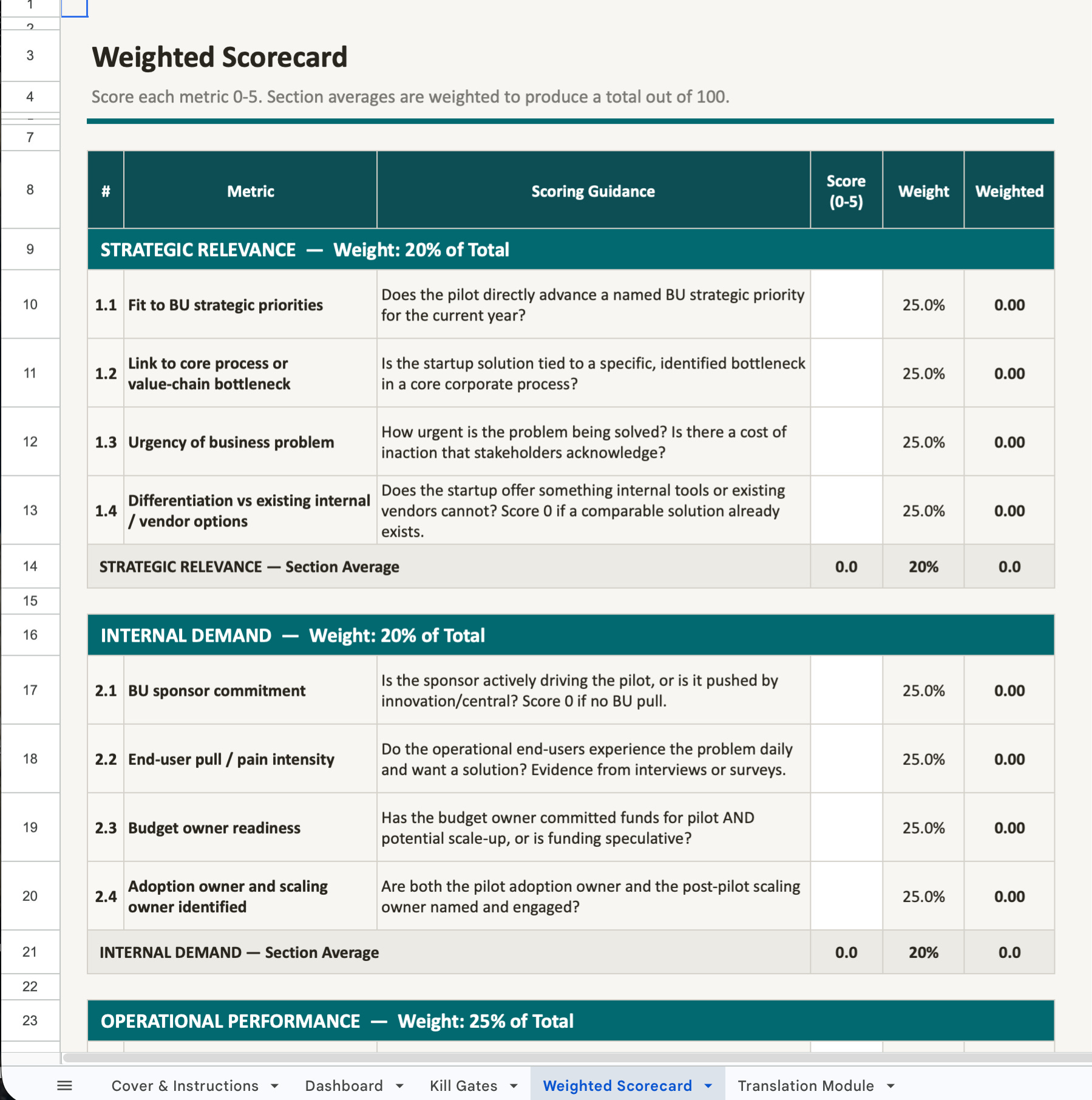
2. The Weighted Scorecard (100-Point Model)
If the Project passes all Kill Gates, the startup moves to the Weighted Scorecard tab. This is where you spend some time, you work through the product.
The Project owner evaluates five key dimensions, whereas fit and strategic alignment are the most weighted criteria. You give them each points, 5 max per section.
To continue to a pilot budget approval stage, a startup must score 75 or higher. Lower numbers should raise some questions. Tip: If you catch yourself wanting to add a point here or there due to feel, discuss these exact points with someone who is less involved and has domain knowledge.
                 THE WEIGHTED SCORECARD ALLOCATION (100 PTS)
  ┌──────────────────────────────┬──────────────────────────────┐
  │ Strategic Relevance (20%)    │ Operational Feasibility (20%)│
  ├──────────────────────────────┼──────────────────────────────┤
  │ Business Impact & ROI (25%)  │ Startup Readiness (20%)      │
  ├──────────────────────────────┴──────────────────────────────┤
  │ Scalability & Rollout Potential (15%)                       │
  └─────────────────────────────────────────────────────────────┘
I. Strategic Relevance (20 Points)
Business Unit Priority Fit (10 pts): Direct alignment with the divisional strategy (e.g., supply chain resilience, automation).
Bottleneck Targeting (10 pts): The solution targets an active operational bottleneck slowing down the value chain.
II. Operational Feasibility (20 Points)
IT & Legacy Integration (8 pts): Feasibility of write-back paths into ERP/CRM systems and API behavior under peak load.
Data Security & Compliance (6 pts): Ability to operate inside the corporate perimeter under real-world privacy regulations.
Resource Load (6 pts): Internal team labor requirements must not exceed 0.5 to 1.0 FTE over the 12-week run.
III. Business Impact & ROI (25 Points)
P&L Alignment (10 pts): Direct mapping to a specific P&L line item or operating expense being reduced.
Cycle-Time Reduction (8 pts): Quantifiable time-to-value gains (e.g., cutting document processing time by 60%+).
Resource Allocation Rule (7 pts): Budgets follow the 70-20-10 rule: 10% on startup license fees, 20% on integrations, and 70% on change management and workflow redesign.
IV. Startup Readiness & Execution (20 Points)
Technology Readiness Level (8 pts): Mature, market-proven tech (typically TRL 4–6 or Series A+ status).
Enterprise Readiness Level (6 pts): Assessed against standard compliance, security, and stability metrics.
Commercial References (6 pts): Active corporate client references validating delivery speed and team execution.
V. Scalability & Rollout Potential (15 Points)
Cross-BU Leverage (8 pts): Potential to scale across other business units or regions on the same foundation.
Vendor Lock-in Risk (7 pts): Modular architecture, IP terms, founder agreements etc, that allow an exit or not.
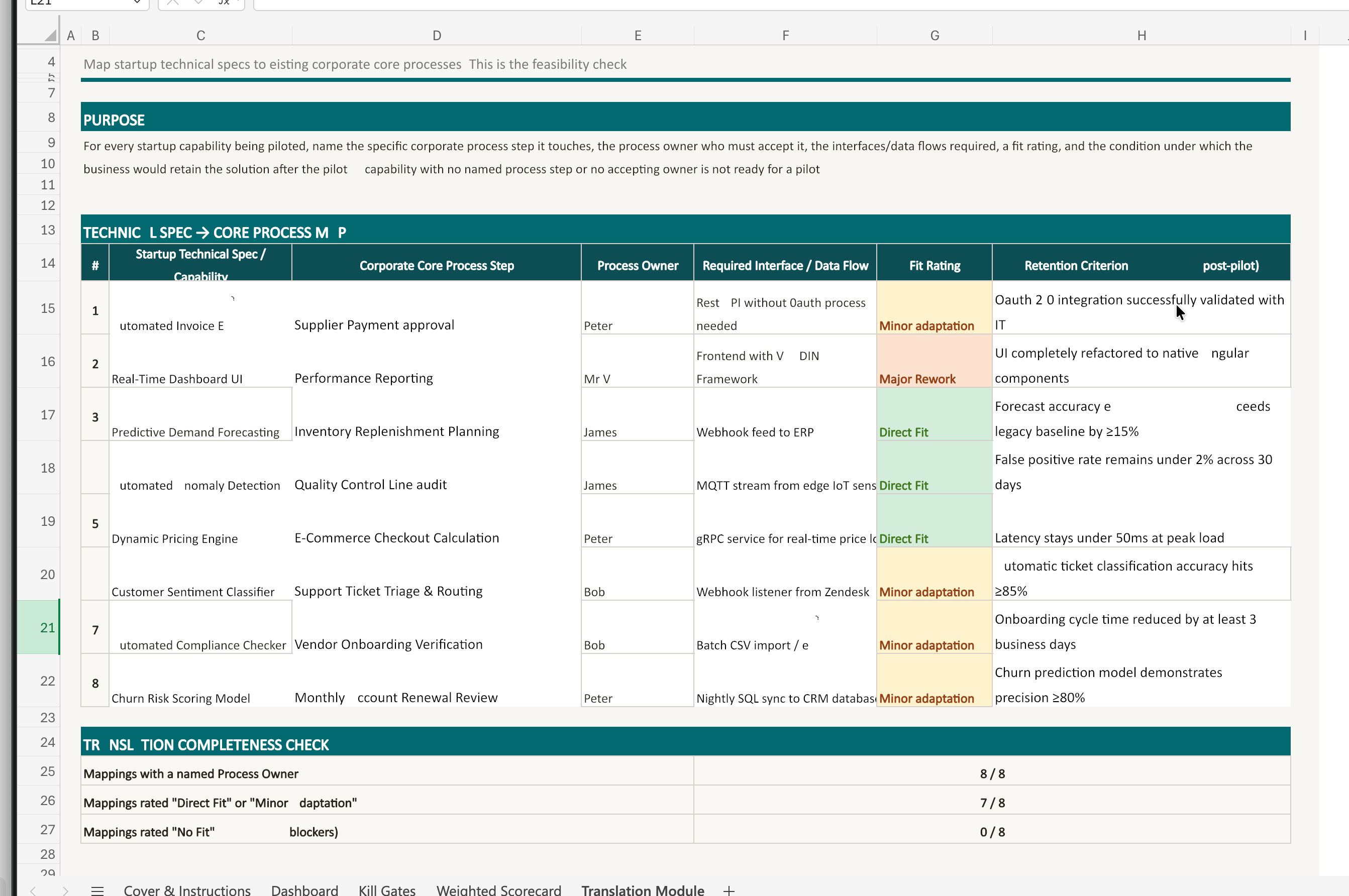
3. The Translation Module: Handover Mapping
The biggest point of failure in corporate-startup collaboration is the handoff. If you built a proof of concept and try to drop it onto a business unit that had no say in its design and process, and they have to take over for you, you offload work to other people. This creates bad blood, and more than often, people simply reject the project.
The Translation Module focuses on mapping technical capabilities directly to the corporate operational bottlenecks. This usually is a balance between detailed deep dives and high level process analysis.
For every startup capability, you want to name the specific corporate process / bottleneck step it touches. You name the process owner who must accept it, the interfaces/data flows required, a fit rating, and the condition under which the business would retain the solution after the pilot. In complex and highly regulated areas such as banking, this is hard and you need a budget to get a lot of people involved. A capability with no named process step or no accepting owner is not ready for a pilot. You can loose a bit of time here, but mapping these will be worth it, a startup has only so so many capabilities the bring into the firm. It could also mean you find capabilities that have to be sunsetted.
┌────────────────────────────────────────────────────────────────────────┐
│                        THE TRANSLATION CHAIN                           │
├────────────────────────────────────────────────────────────────────────┤
│  Startup      ──>  Corporate  ──>  Accepting  ──>  Data  ──>  Retention│
│  Capability       Process Step     BU Owner        Flows      Metrics  │
└────────────────────────────────────────────────────────────────────────┘
Startup Capability: Name the specific feature or IP (e.g., real-time OCR for invoices), so other people understand it without needing a 5minute pitch.
Corporate Process Step: Identify the exact step in the current process chain where the bottleneck lives.
Accepting Process Owner: The operational owner explicitly agrees that if the capability automates or speeds up this step, they will adopt it.
Required Data Flows: Map input/output sources, API write-backs, and human-in-the-loop validation requirements.
Retention Conditions: Lock in the exact operational metrics that automatically trigger a long-term commercial contract post-pilot.
🛑 On Sandbox Pilots
Models with 92% accuracy in testing routinely drop to 67% live. Thus, the scorecard has to penalise sandbox-only tech, to avoid building tech demos. If it is but a prototype, yet completely groundbreaking to your industry, maybe hand it over to M&A and directly buy it, and build it in-house directly.
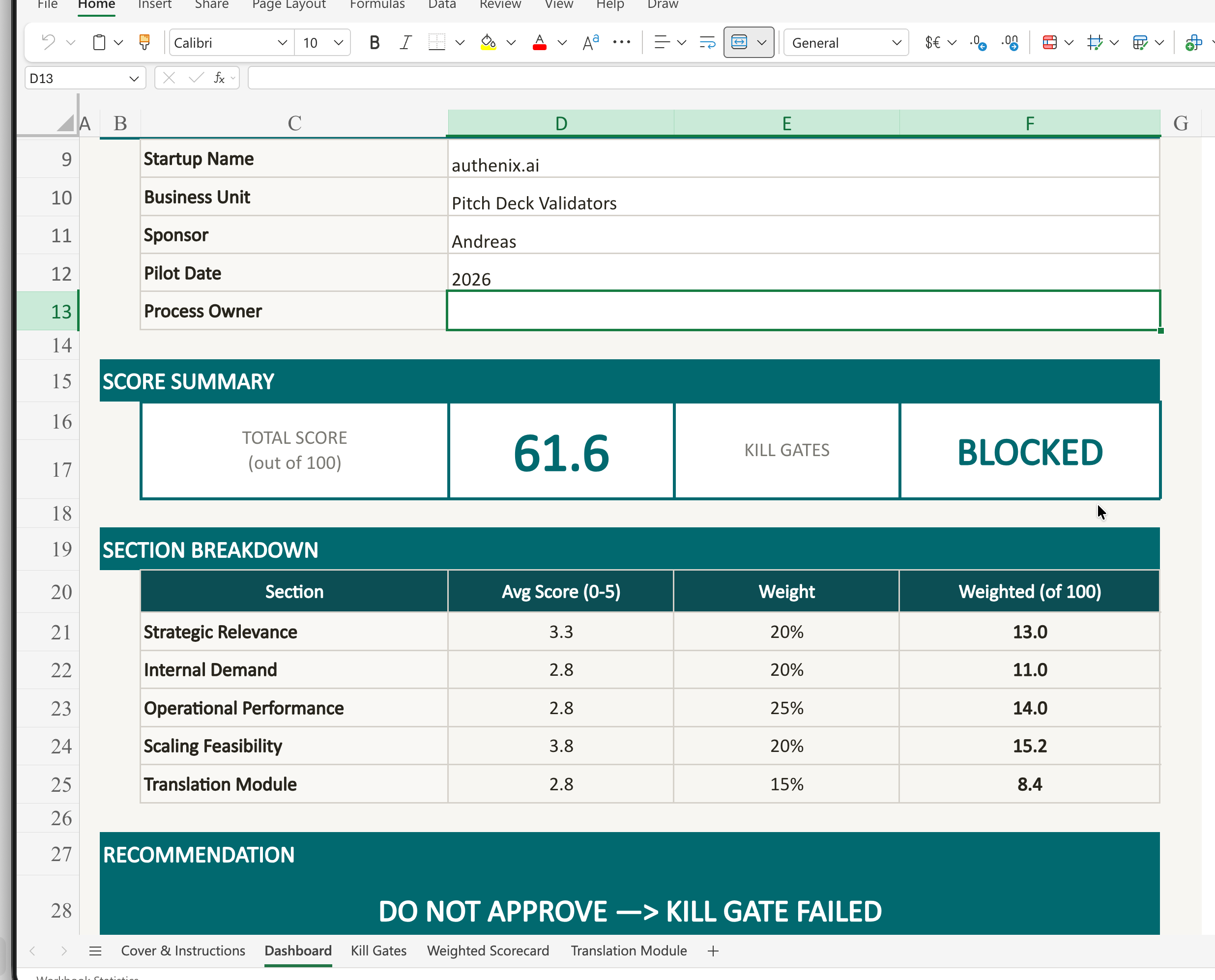
Once you are done, check the dashboard for the updated numbers.
Takeaways
People are easy to motivate and try out exciting ideas. But having someone go through an entire implementation cycle for you is a different story. Enterprise data is often inconsistent, legacy systems are fragile (or have incredibly complex legacy, like SAP), and yes, business units reject tools that create more manual overhead than they remove.
If a startup cannot survive dirty production data, or if you cannot name the exact manager who will sign the purchase order when the 90 days end, consider to drop the project. A successful pilot program is defined by how early it shuts down unviable work, not how many initiatives it passes.
To summarise the takeaways from the checklist:
Kill Gates Save Money by Saying No Early: The primary goal of a pilot framework is to kill unviable projects fast. When there is no named process owner willing to accept the tool-implementation that has to be a red flag.
Sandboxes Lie: A successful demo on clean data proves nothing about enterprise readiness. Always score a startup when considering compliance hurdles and legacy data.
Map the Handoff Before You Sign: If you cannot draw a direct line from the startup’s feature to a specific corporate process step, it won’t bring relevant change.
Put This Framework into Practice
Subscribe to Download the Startup Pilot Scorecard Excel Template. Make a copy for yourself, as it is a locked file on google drive.
If you want to talk about corporate innovation or strategic business development, Book a short 1/1 to pick my brain.
Want to read more on Venture Clienting? Try these two articles by Gregor Gimmy.
History on Venture Clienting:
https://medium.com/@gregor_gimmy/venture-clienting-definitions-and-history-66cf01e9b480
On good venture clienting:
https://ventureclient.org/ventureclientthinking/library/what-is-a-good-venture-client-company/